author: niplav, created: 2026-04-17, modified: 2026-08-31, language: english, status: in progress, importance: 1, confidence: possible
An exercise in heartfelt futility.
In this essay I want to engage and grapple with some questions around the interplay of craft and purpose, in a time when it's plausible that much or all of human activity could be automated soon, and it's possible that the interim period will allow for individuals to exert large amounts of influence on how the future goes.
Specifically, I want to mourn the notion of craft, namely highly skilled and attuned human activity that some people dedicated their entire lives to, and illustrate this with several examples I find especially vivid.
I want to contrast this with the interim period which has arguably already begun, in which cultivating a craft runs the risk of being automated away, and instead encourage myself and others to pursue purpose even when we feel drawn to becoming skilled craftspeople.
This whole line of thinking was set off by skimming over Ergosphere's1 post "The machines are fine. I'm worried about us.". It is a good blogpost, and I suggest you read it, but if you don't:
Ergosphere tells the story of Alice and Bob, both starting an astrophysics PhD. Alice grinds through her first paper assignment on her own, Bob vibe-physics it with an AI agent, consequently Alice emerges a more capable and skillful human being at the end of the year she spends on the paper, while Bob coasts and learns nothing. The papers they produce are of similar quality (though the post is unclear on how certain and robust the equivalence in quality is (…let's put a pin in that)), but ergosphere hammers home that the paper is, in some sense, irrelevant; the actual goal of the PhD is to produce capable people, not research artefacts.
Ergosphere goes on to write about how only people who have done the grunt work can actually tell good AI outputs from bad AI outputs, and the grunt work is easily avoided as people do everything to avoid doing the real thing/hugging the objective.
The post draws the distinction between "tool use and cognitive outsourcing", and encourages readers to use AIs as tools, and not cognitively outsource to them, as to build up the necessary skills to distinguish between good and bad outputs, noticing code smells and suspicious tells, developing taste and wisdom.
I respect this post. I've felt it. And… I want to write a requiem to the world in which it applied. I want to grieve that I'll have to leave behind a world in which becoming a more capable person is, indeed, one of the best things to do with ones time. I want to grieve that ergosphere is, as far as I can tell, wrong.
I also like it because it made me think. Remember that pin we put in it, three paragraphs ago?
Ergosphere is, themselves, not quite consistent in how they judge the quality of the output of LLMs. They write that Alice's and Bob's papers are identical in quality (or at least publishability), but then later talks about how Claude confabulated/reward hacked results in an experiment by Matthew Schwartz, and how "[s]tronger models won't eliminate the need for a human who understand physics".
The question on whether stronger AIs won't eliminate the need for a human who checks outcomes is, I think, a (the?) crux between ergosphere and the Bobs of this world (and also me, though see the rest of the text for subtleties).
In one world, which ergosphere appears to expect: AI as a normal technology, business-as-usual with better tools, the risk of cognitive atrophy but also the advantage of being able to provide capable supervision. Planning for the future is worth it.
Though, ah, even business as usual puts a high discount rate on the value of becoming highly skilled at a specialized activity…
In the other world: Ultraintelligent machines. Transformative AI. The Singularity. The Hinge of History. Possibly: Nothing Human Makes it Out Of The Near Future. (Unless: Pause/Control AI. "Thou shalt not make a machine in the likeness of a human mind". Movement 78. The Brink.)
Indeed, I put a probability of ~70% on us being in that fearsome other world, and that being quite frightening (primarily due to superintelligences leading to human extinction, but also concentration of power to a small group of humans, loss of lots of value even though humans don't technically "go extinct", and stranger badnesses such as (if we're in a simulation) that simulation being shut down).
But: That's not the only things that will happen. Even if these scary events don't happen, or take a while to happen, there is a very specific loss that ergosphere tries to point at and warn about, and that I also want to honor in detail.
By "craft" I refer to a human engaging in an activity for so long and to such a degree of skill that the human, in turn, is meaningfully shaped by that activity so that their being entwines with the activity. Craft, in my mind, is associated with the image of a highly skilled blacksmith or weaver whose body and mind have been changed by decades of engaging in their profession, who have intricate and embodied understandings of the materials and tool of their craft, and whose eyes and hands and feet are intuitively involved in the activity. I feel myself reaching for Heideggerian terms such as "Zuhandenheit" and "In-der-Welt-sein" to describe a human engaged in a craft, though I'm not sure they're fully applicable here.
Instead of further defining "craft", I'll instead satellite it extensionally, examining three different instances of it (two, mostly dead; one, dying) and then turn to how AI might entail a total loss of craft, and what that loss means for craftspeople.
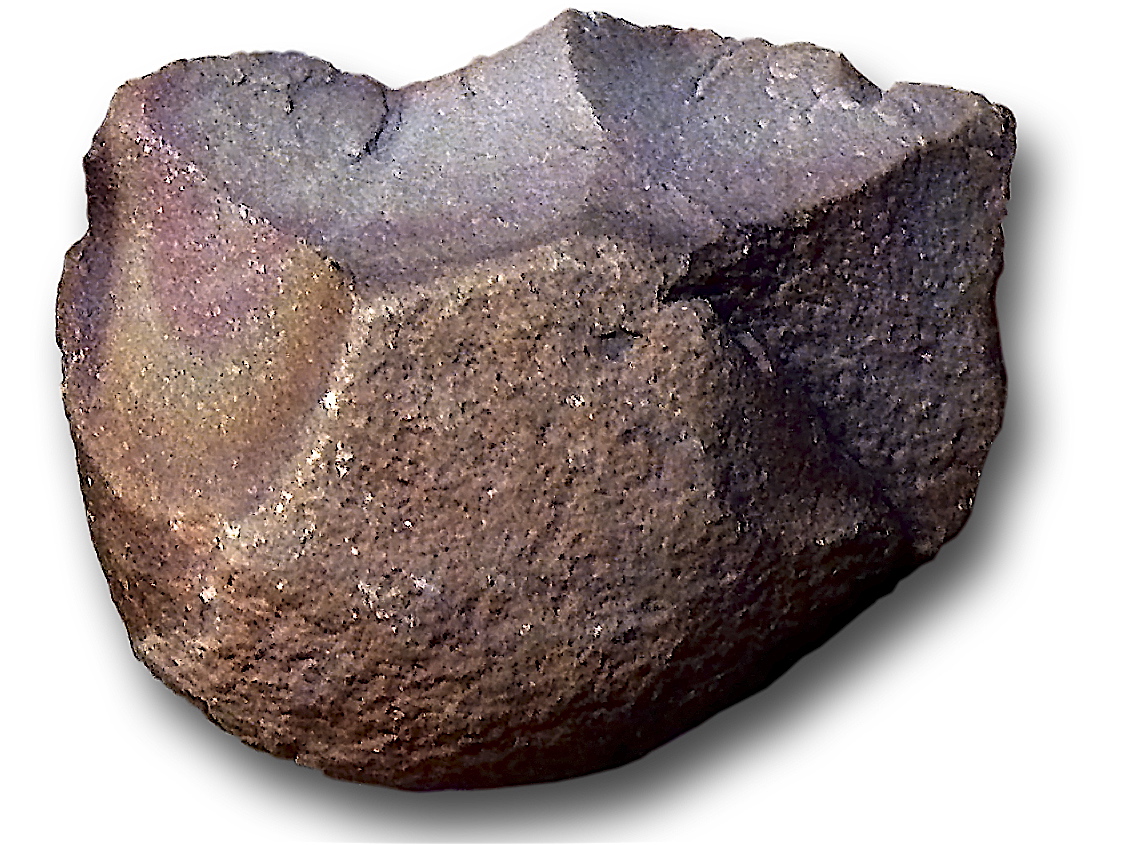
Did you play with stones as a kid? If you did, you may remember having tried shaping stones into something useful (or at least, useful-to-you back then). I'm pretty sure you didn't succeed at your goal unless your ambitions were very low. After recently reading Altair writing on the topic and weakly recommending one try to make stone tools, I idly tried during a pause on a hike to find two stones and reshape one into an Oldowan tool. I failed miserably, not getting anywhere close to even something like this:
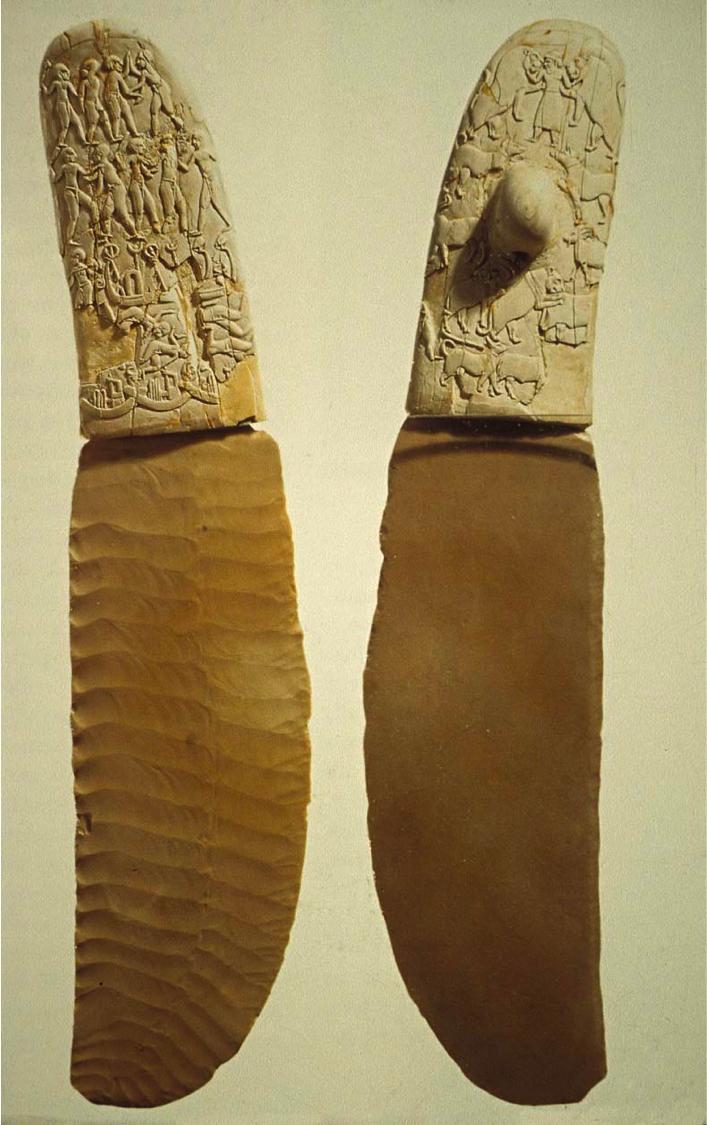
Humans, over history, got really good at shaping stones into tools. I fear that you, the reader, might default to skimming over the pictures here, not internalizing the magnificence of these tools. They are. You're looking at artistic works of extreme and deep skill, made by lithic virtuosos with what I'd guess were sometimes tens of thousands of hours of experience, with an uncanny ability to see through the flint and trace its lines of weakness, a sharp David to be knapped into bladehood.
Flintknapping likely had whole lineages of teachers, and hunter-gatherers probably had significant specialization along broad categories, as we learn from the stories of Ishi—humans who spent every day with the stone, who in some sense acquired stone-nature.
The culmination of hundreds of thousands of years of refinement in flintknapping is tools like the Gebel-el-Arak knife. Many people focus on the handle, which is indeed stunning, I want to focus on the blade. It almost looks like it is made from modern ceramics, cast instead of knapped, but no, even a blade this thin was first pressure-flaked into chert by a Paganini of quartz, and then polished.
I have a pet theory that flintknapping was the activity that allowed for a social niche for autistic people in hunter-gatherer groups30%. Paleolithic humans had to spend thousands, maybe tens of thousands of hours to learn how to knap arrowheads, knives and axeheads. The kind of person who is able to sit at camp, every evening, not engaging with the others but instead obsessively inspecting the exact way in which obsidian flakes off when pressed at a slightly different angle… does that remind you of people? Maybe even yourself? Being able to gift better stone tools to others confers social status, which can be converted into reproductive success.
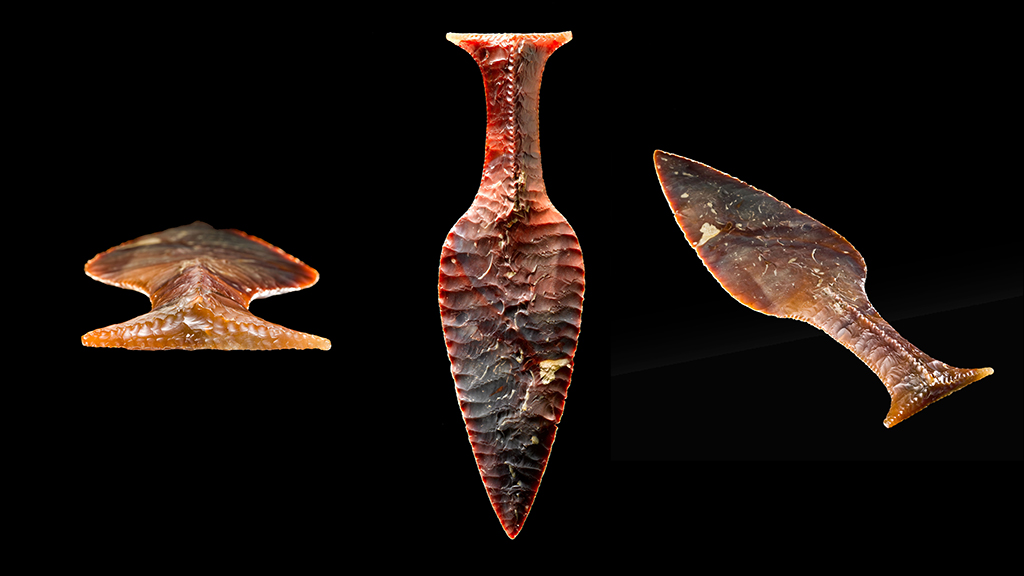
But flintknapping doesn't just produce tools—sometimes the resulting objects are too fragile, too ethereal to be used as anything but ritual objects. The Hindsgavl dagger is an example of such an object, forged of deep craftsperson ability, weeks or months of careful pressure, a slow and methodical chipping away where any wrong pressure breaks the damn substrate, to have start again. A Platonic dagger flaked out of a volcanoes cooled blood.
"What about marble statues? Aren't they much more impressive, given that they're not a simple geometric shape (a blade), but delicate statues? Is the Nike of Samothrace not infinitely more impressive than the Hindsgavl daggers? And is this not an argument against your case, since we have skulptors today who can make status that are as impressive as the Nike?"
Thank you, hypothetical interlocutor! I do find marble statues to be pretty impressive, but not more (or at least not much more) than knapped flint.
This stems from two roots, namely:
Arguably, creating stone skulptures is still a respectable craft (though slightly impressive when done with a pointing machine, and direct carving a full complicated statue is afaik dead as a craft).
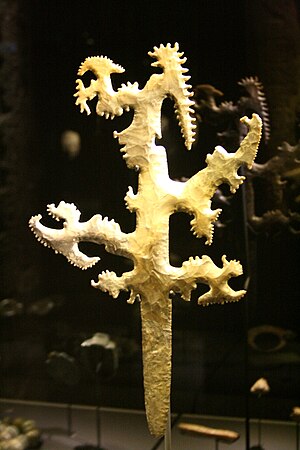
Knapping reached its roccoco height in the eccentric flints created by Maya maestri, possibly spurred on by the relative lack of metallurgy in pre-Columbian meso-America. I do not find these beautiful, per se; my aesthetic is one of simplicity: please give me the stark elegance of a chipped obsidian arrowhead instead. Instead these flint are splendid, impressive, decadent, yes, definitely eccentric. Where the Hindsgavl dagger and Gebel-el-Arak knife are sonatas, an eccentric flint is a fantasia.
I can admire them in the abstract, as craft finally unmoored from even the pretense of utility.
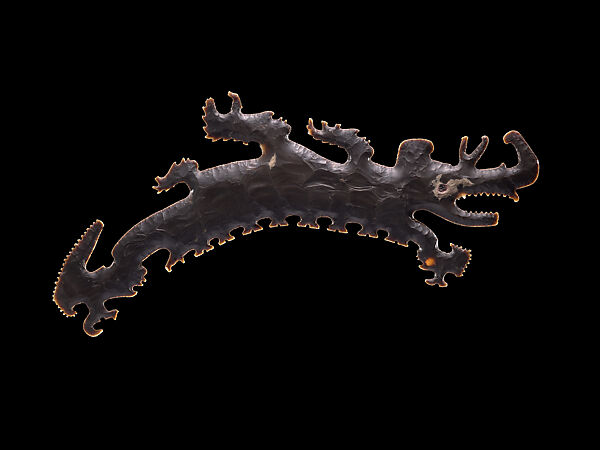
The second craft I want to mourn is an even older one, the craft of tracking.
As to the question of tracking, the idea which has been generally held, that the shoes are used to prevent the tracks being seen will not be regarded as at all satisfactory by those who are acquainted with the remarkable power of the Australian native in this respect. They will neither hide the track nor, though they are shaped alike at each end, will they even suffice to prevent any native who cares to look from seeing at a glance which direction the wearer has come from, or gone towards. Any even moderately experienced native will, without the slighest difficulty, tell from the faintest track—from an upturned stone, a down-bent piece of grass or a twig of shrub—not only that some one has passed by but also the direction in which he has travelled. The only way in which they can be of use in hiding tracks is by preventing it from being recognised who was the particular individual, and in this way they might be of service, for when once an experienced native—almost incredible though it may sound to those who have not had the opportunity of watching them —has seen the track of a man or woman he will distinguish it afterwards from that of any other individual of his acquaintance.
—Baldwin Spencer/Francis James Gillen, “The Native Tribes of Central Australia” p. 483, 1899
I imagine that if I witnessed this kind of ability, it'd look like magic2 to me. And yet, there were entire cultures where this kind of ability was as fundamental as literacy is in ours!
I'm also almost certain that all the best trackers are long dead, and that present-day hunter-gatherer groups are too small to have transmitted all the knowledge from the past, or that (e.g. with the Hadza) the surrounding industrial civilization relieves some of the pressure to drive the art to its peak, and that Louis Liebenberg and Mark Elbroch are a step of skill below those present-day hunter-gatherers.
We get glimmers of this depth in some anthropologies, for example in the Story of Short Kwi:
Among the Bushmen of Nyae Nyae in Namibia during the 1950’s, the man known as Short Kwi was famous for his hunting prowess. Tales were told of his great achievements in the chase—the time he killed an eland, a wild pig, and a wildebeest in a single day; the time he killed four wildebeest in a large herd—his exploits were legendary.
He was said to be a relentless pursuer who almost never lost an animal. He could pick up a cold trail even over stones. He deduced subtle clues from fallen leaves, such as whether they had been disarrayed by the wind or the movements of his prey. The meat from his pursuits was never wasted, as it was shared liberally and dried to last weeks.
He had encyclopedic knowledge of the animals in his environment—from the smallest mice to the largest antelope, he knew by heart their habits and where they could be found. Elizabeth Marshall Thomas writes that, “He knew every bush and stone in the area of thousands of square miles that he ranged over, and he lived for hunting."
While the Bushman practice of ‘shaming the meat’ to prevent an effective hunter from getting a big head is well known, with Short Kwi, “his great ability set him so far apart from ordinary mortals that for once the Bushmen forgot their jealousy and agreed that he was the best hunter the Kalahari had ever known.”
— William Buckner, “The Sad Story of Short Kwi, Legendary Hunter of the Kalahari”, 2022
This third one is closer to my heart.
it's strange to see the world of the past fade before my eyes
from 2012 through 2024, I wrote code in long sessions of sitting in vim -- sometimes typing, mostly thinking, flipping between different terminals, making changes, looking at errors, googling, reading stackoverflow...
I took pride in carrying in my head these towering abstractions. I knew every nook and cranny of my business logic, like a neighborhood you live in. I felt extra fast when tab-completing a single long variable name. Nice. I placed every parenthesis, every semicolon, myself. Hundreds of thousands of them.
And like a great wave washing over your sandcastle on the beach, it is now all gone. Engineering will never again be as it once was.
What's especially significant about it to me is that there's barely a record of the way it was: I've spent thousands of hours writing software, and I don't think there's a single video recording of me doing it.
I remember how it was: the long breaks of meditative silence, the frustration of hunting a particularly tricky bug, the relief and joy in solving it, the expressions of taste and cleverness that come with any manual craft.
But it's hard to communicate how it was to someone who has never experienced it. As with all histories, the narrative is lacking in depth: you really had to be there.
— John Loeber, Tweet, 2026
I was recently rewatching Silicon Valley, and was surprised by the pride that Richard & Dinesh & Gilfoyle put on their technical ability in software engineering and systems architecture, in algorithm design and reliability engineering. That had been my aspirational pride, too, after reading Eric S. Raymond's FAQ as a 14-year old, and decided I wanted to become a great hacker, in the hacker culture sense.
I think I'd forgotten this part of my psyche, swept by the Gezeiten3 of AI progress around me, silently and unconsciously giving up on the aim of craft, of becoming really fucking good at writing crisp and crystalline code in the tradition of the monastic order of the suckless. I hadn't even quite realized that this part of me was unhappy that something important had been taken away with the release of Claude Code, back then in early 2025.
I had been robbed of the opportunity to become Mel.
There was another, similar, moment when I installed Claude Cowork for my partner on their work laptop to test how good it'd be at their job. We gave it a simple task of setting up an oneline form, and sent Sonnet grinding away. We watched Claude work (surprisingly slowly, compared to Claude Code!) away on it while we were cuddling. It felt… irreal. Watching something important sublimate in the middle of its existence.
The weaver in front of the industrial loom, the medieval blacksmith before the factory with a blast furnace.
Importantly, the main thing on my mind here is not really about programming, it’s the nature of seeing something change and totally go away, fade in real-time, with the actual way that it once was being impossible to record or to really convey
— John Loeber, Followup Tweet, 2026
If we are in the other world of full automation and human obsolescence and |disempowerent⟩+|Deep Utopia⟩, then we will lose all basis of craft.
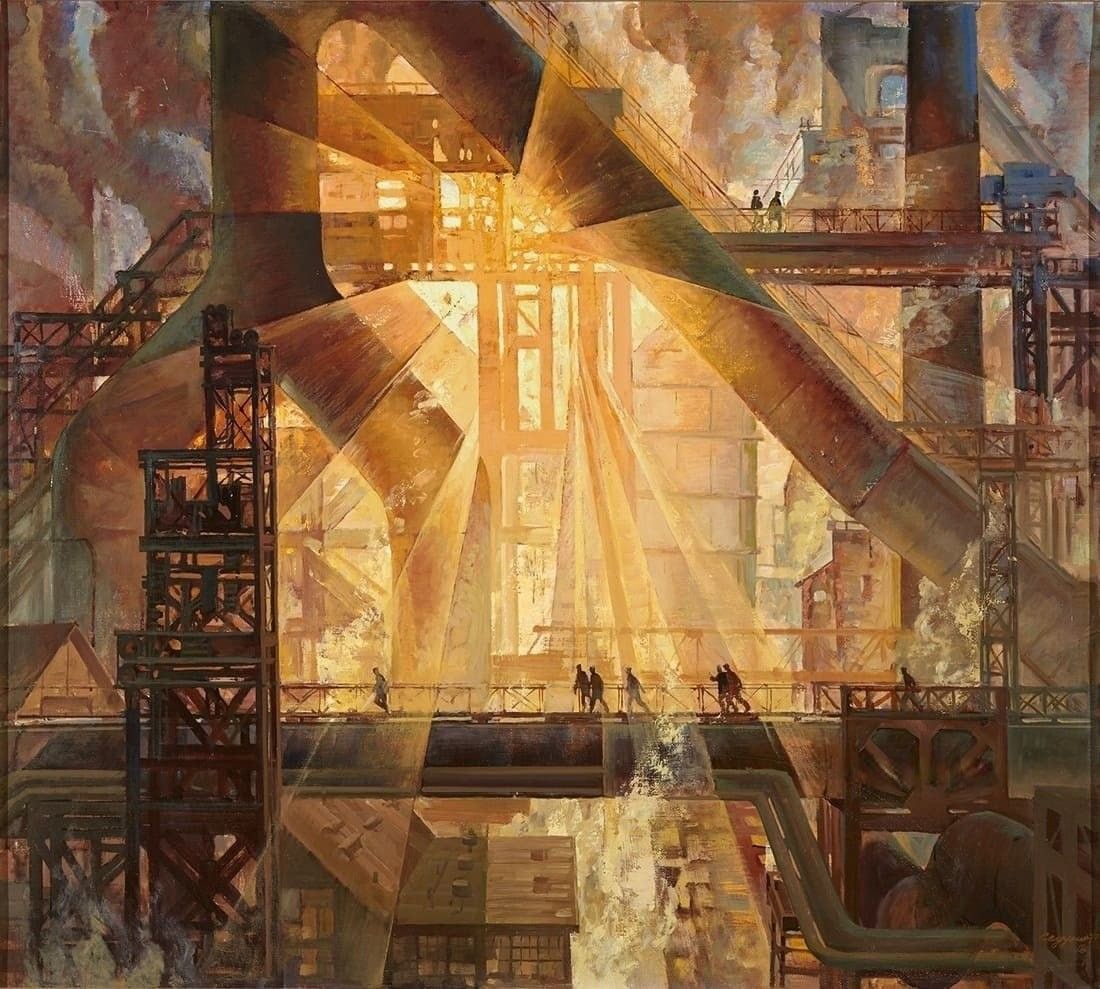
A new star is rising on the firmament
This type of loss is not new, per se. I've named two crafts that have ~completely disappeared, and there are many others (reciting the Iliad or the Vedas from memory, marine navigation by stars, blacksmithing…) The loss of craft is one of the diseases of the soul that the golden goose of civilization demands from us. But, so far, as far as I can tell, one wasn't expected to deal with more than one loss of craft in ones lifetime, not to speak of the whole damn rug being pulled away from under oneself.
Every now and then reality jerks your craft away from what is necessary, see Short Kwi, the flintknappers, the Iliad-singers, the weavers and blacksmiths, the software engineers and geometers, this happens rarely and slowly enough that a human will experience it at most once in their lives, maybe not even that.
Sure, one could technically continue to practice the craft in ones free time, but what a hollow answer! I am a human who wants to turn himself into an instrument for a craft, which is purpose, as long as it connects well enough to reality.
This loss was tragic whenever it happened! It was horrible! Such deep skill was lost, such incredible finesse! LOOK AT THE HINDSGAVL DAGGERS!
…
And now, the whole thing. "All that is solid melts into air, all that is holy is profaned, and man is at last compelled to face with sober senses his real conditions of life"
Sometimes (okay, almost always) the attachment to a particular craft does not go quietly.
There is no good replacement word for "cope" in English, truly an incredible coinage.
None come close: "Sour grapes" is purely about giving up on possibly valuable things, "rationalization" and "denial" are too clinical, "motivated reasoning" is too wordy.
"Cope" covers it all, from denying the existence of the fact that one might never be truly loved, to (ineffectually) dealing with the fact that your neighbour has a cooler car than you; it can function verb, noun and imperative; it's not purely dismissive but not exculpatory either. I don't know how we managed before 4chan gave it to us.
A common reaction to losing ones craft is cope.
Because this is me, and this is my essay, I shall illustrate this with a German poem. The context for this poem is that during the industrial revolution, the silesian artisan weavers were being automated, and the poet Heinrich Heine wrote an fiery war cry in their name4:
Im düstern Auge keine Träne
Sie sitzen am Webstuhl und fletschen die Zähne:
Deutschland, wir weben dein Leichentuch,
Wir weben hinein den dreifachen Fluch -
Wir weben, wir weben!Ein Fluch dem Gotte, zu dem wir gebeten
In Winterskälte und Hungersnöten;
Wir haben vergebens gehofft und geharrt -
Er hat uns geäfft, gefoppt und genarrt -
Wir weben, wir weben!Ein Fluch dem König, dem König der Reichen,
Den unser Elend nicht konnte erweichen
Der den letzten Groschen von uns erpreßt
Und uns wie Hunde erschießen läßt -
Wir weben, wir weben!Ein Fluch dem falschen Vaterlande,
Wo nur gedeihen Schmach und Schande,
Wo jede Blume früh geknickt,
Wo Fäulnis und Moder den Wurm erquickt -
Wir weben, wir weben!Das Schiffchen fliegt, der Webstuhl kracht,
Wir weben emsig Tag und Nacht -
Altdeutschland, wir weben dein Leichentuch,
Wir weben hinein den dreifachen Fluch,
Wir weben, wir weben!"
— Heinrich Heine, “Die schlesischen Weber”, 1845
Heine inadvertently describes the cope perfectly: The reaction to the rising tide is not nimble action, but denial and accusations and a doubling-down on the very thing that has no power anymore. Ihr webt, ihr webt, but what use does that have? The mechanical loom over there could be coping much harder than you, too.
I've felt this cope (and seen it in others!), multiple times, seeing the LLMs flood a skill I have, and then coping "but they can't do X yet!!!"; visual artists5 and software engineers and musicians and mathematicians scream "no! not me! I won't be afflicted by the age of mechanical production!"
No. Stop. Let go. Feel into your cope, give yourself a hug, and then drop it. Nothing Human Makes It Out Of The Near Future. I'm Sorry. :-|
Nick Bostrom's Letter from Utopia is on of my favourite pieces of writing, ever. It takes the perspective of distant future posthuman eutopians trying to communicate to us, beckoning us to come closer, to become them, to join them at the Festspiel forth then6 in Heaven. I've cried many times upon listening to/reading over it, a unique and to me uncommon religious experience—and I'm not the only one.
Another one of my favourite pieces of writing is Hyperions Schicksalslied by the German romantic Friedrich Hölderlin.
It is the dual of the Letter, which speaks to us in the voice of the Posthumans. Hölderlin, on the other hand, addresses them from our perspective.
Ihr wandelt droben im Licht
Auf weichem Boden, selige Genien!
Glänzende Götterlüfte
Rühren euch leicht,
Wie die Finger der Künstlerin
Heilige Saiten.
The Posthumans are cradled by a soft and ubiquitous sysopmind, touched only softly by the most refined aspects of reality. They dwell in the realm of the devas, unperturbed.
Schicksallos, wie der schlafende
Säugling, atmen die Himmlischen;
Keusch bewahrt
In bescheidener Knospe,
Blühet ewig
Ihnen der Geist,
Und die seligen Augen
Blicken in stiller
Ewiger Klarheit.
No Purpose drives them, no Need propels. Purpose has been handed off and completely spent; the world has reached a final orbit, and its inhabitants reside in fatelessness and eternal clarity. Craft is even less necessary than Purpose, now hidden somewhere deep inside the machinery that underpins the new world.
Whether such a world is a good world, and what the posthuman Genien would be doing, exactly, is the purpose of another book.
We are decidedly not in the world of the Genien yet. Perhaps, at some point, we'll be enveloped. But not right now. Right now we hold the largest levers over the pulleys and cables of history, the dials for the circuit of the lightcone, the switches for the machinery of night.
We are, as the saying goes, in that awkward phase between being being born and dying, but we are also (if I'm correct7) about to enter that awkward phase between losing Craft and losing Purpose.
In such a case seeking cope in Craft, doubling down on that ancient and familiar safety, will do no good. You will waste your time, you will be jolted by reality as your craft is rugpulled out from under you, only to finally realize that all relevant time has passed, and all your levers have disappeared.
Thus, my sad and desperate battlecry: Do not shape yourself into an instrument of deep skill. Look instead at the world, grab all the {levers, AI agents, convergent instrumental strategies} you can plausibly get, and instrument the universe into the direction you desire.
Craft is clearly ill, its bubos swelling in mathematics and software engineering — it will die, how long the course is not certain. Mourn it, sings to it elegies, nurse its healthier parts with expendable free energy, but do not ally with it.
Time is precious, now, and focus and attention are, too. Yet you have write access to the universe, yet it yields. The window is closing, and we are on triage every second of the day. Do not cope.
Now Is The Golden Age of Purpose.
Doch uns ist gegeben,
Auf keiner Stätte zu ruhn,
Es schwinden, es fallen
Die leidenden Menschen
Blindlings von einer
Stunde zur andern,
Wie Wasser von Klippe
Zu Klippe geworfen,
Jahr lang ins Ungewisse hinab.
The author is named Minas Karamanis, the blog has the domain ergosphere.blog; I'll call the author "ergosphere" from here on, since it's such a cool word and concept. I hope they don't mind. ↩
"Magic" in the Yudkowskian sense, in that it's a thing that is so far outside of my understanding what's possible that I can't even rederive that it could work. ↩
Alright, this word choice I'll explain a bit. "Gezeiten" means "tides" in German, but "Zeiten" is also translateable as "times", and the "Ge-" prefix indicates something that is occurring/being done. So the best translation her would be "tidal times-ings", but even that's not perfect. Forgive my attempts at load-bearing multilingual puns. ↩
In this whole text, I will not translate the German to English, as doing so would damage something fragile in the meaning I'm trying to get across. I recommend (but do not mandate) that you consult your favourite large language model to find you an adequate translation. ↩
I fully believe that neither art nor music are as close to being automated as e.g. software engineering and mathematics are. I do think that they will be, soon, and that the reaction would be the same either way. ↩
Thanks to Sonnet 5 for this construction. ↩
I may still be wrong! Oh god please ↩